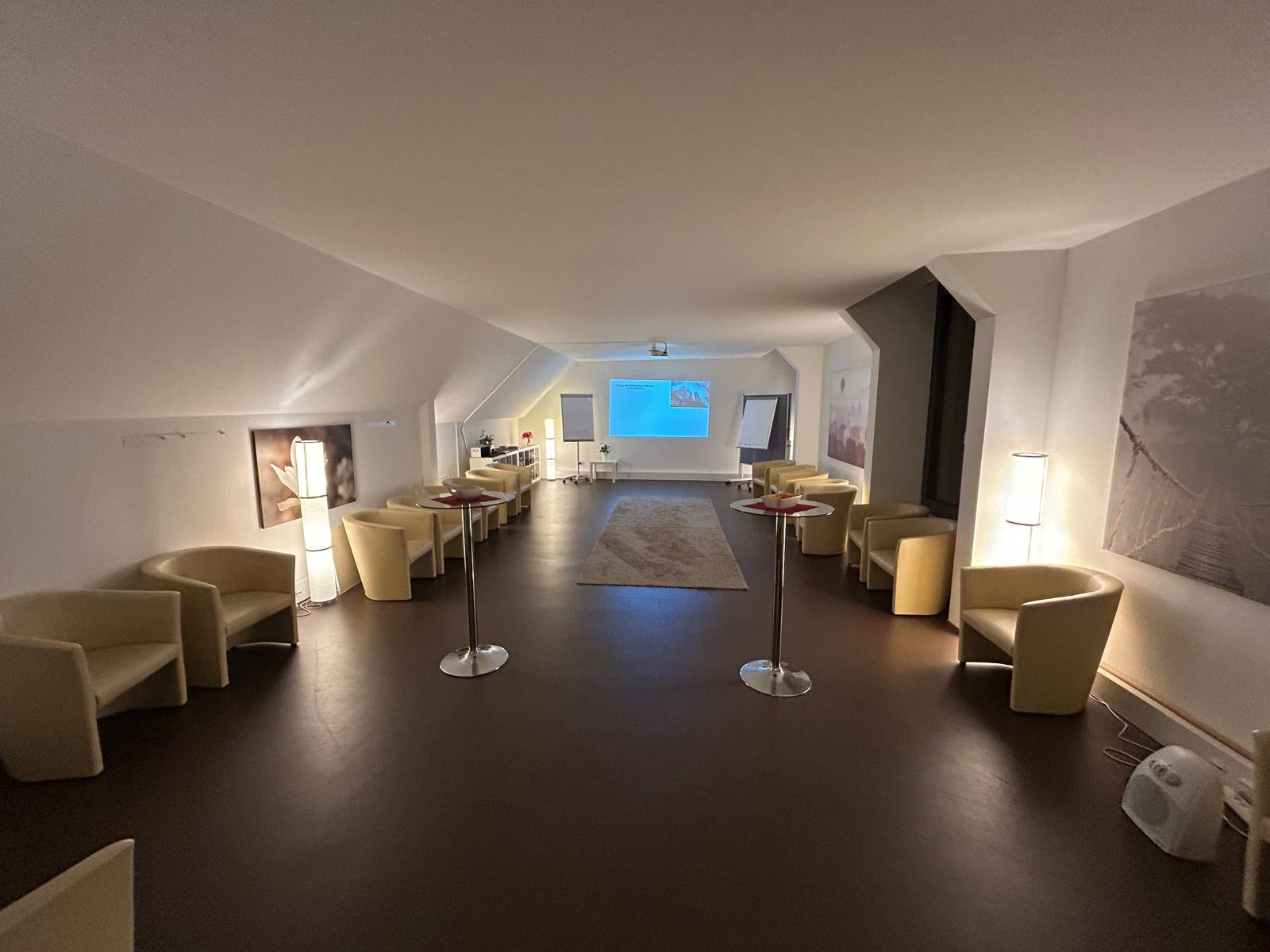
Last week, we were invited by the HSG Students’ Soft Skills Club to speak about one of the topics closest to our hearts. The University of St. Gallen – a place that stands for excellence, achievement and the future. And at the same time, a space where something else became possible: an honest glimpse behind the façade of modern leadership. As soon as we walked in, it was clear that this late afternoon would not be a traditional lecture. Too much is in flux, too much is at stake, too many systems are still functioning – but internally, they are showing cracks. And that is exactly where we started.
Not with strategies, not with models, but with a thesis that silenced the room for a moment: most transformations fail not because of a lack of concepts, but because of fear in the boardroom. An uncomfortable truth – and yet one that many can feel immediately. For what happens when leadership is born of fear? Then control becomes a substitute for trust. Activity is confused with effectiveness. Security is prioritised over purpose. Organisations appear strategic and professional to the outside world, but internally they operate in survival mode. And systems in survival mode cannot truly change. That is precisely the Leadership Fear Trap.
Under the title “More than money – the invisible power of holistic leadership in banking”, we have explored this idea further. For it is in banking, in particular, that this dynamic is most clearly evident. It is no longer just about money, nor is it just about products or markets. It is about trust, about purpose, about the question of one’s own raison d’être. What use is the best business model if nobody really believes in it anymore? What good is digitalisation if the culture does not evolve alongside it? Perhaps that is why the next major crisis will not be a financial crisis, but a crisis of purpose. And it was precisely this perspective that stirred things up in the room.
Many organisations respond to today’s complexity with more of what they know: more tools, more speed, more optimisation. But in reality, they are often trying to rescue an outdated internal system using new external methods. Artificial intelligence is implemented, processes are streamlined, strategies are reformulated – but the underlying patterns of thought and behaviour remain the same. And that is precisely why all of this falls short. Because what does not change on the inside cannot be transformed sustainably on the outside.
We live in an age in which it is not just markets that are changing, but our very understanding of leadership. It is more than a change – it is a shift in consciousness. Away from mere knowledge, towards genuine awareness. Away from control, towards trust. Away from mere functionality, towards purpose. The questions are changing – and with them, the answers. Suddenly, it is no longer just about becoming more efficient, but about remaining relevant at all. Not just about achieving goals, but about what we are actually striving for.
This also fundamentally changes the role of leadership. It is less about having the right answers oneself, and more about creating spaces where new answers can emerge. Less about solving problems, and more about empowering people. Less about demonstrating performance, and more about enabling impact. Leadership thus becomes an inner practice – an attitude that begins within the individual and unfolds within the system.
Holistic leadership describes precisely this approach. It combines self-leadership, relational skills and systemic thinking into a vibrant whole. It invites us to understand leadership not merely as a function, but as an expression of consciousness. For those who cannot lead themselves will not be able to lead a system sustainably either. And at the same time, true effectiveness only emerges when leadership becomes a space in which collective intelligence is possible – where people do not merely function, but grow, connect and jointly create something greater than themselves.
What made this evening at the HSG special, however, was not just the content. It was the quality of the encounter. Young, thoughtful people who ask not just how they can become successful, but why and for what purpose. An openness that was palpable. A depth that was moving. And that moment at the end, when the central question hung in the air: How does this affect you? Not as a rhetorical conclusion, but as a genuine invitation.
Because, in the end, everything comes down to this. Not strategies, not technologies, not markets. But the mindset of the people in charge. And perhaps that was the most significant development of the evening: not providing more answers, but broadening our perspective – through a genuine shift in outlook.